Single Tooth Dental Implants in Leduc: What to Expect
A single tooth implant replaces one missing tooth with a titanium root that sits in your jawbone, topped by a connector and a crown made to match your other teeth. It stands on its own, and usually takes several months from placement to the final crown.

Dr. Kyle Lesko

The quick version
A single tooth implant is a titanium root in your jawbone, joined by an abutment to a crown. It does not rely on the teeth beside the gap.
Expect several visits over several months, because the implant must bond with the bone before the final crown goes on.
Swelling and tenderness are common for a few days after surgery. One small study describes the discomfort as mild to moderate, mostly in the first three days.
Implants and their crowns have high long-term survival, but smoking, gum problems and grinding raise the risk of trouble.
As of November 2026, the Canadian Dental Care Plan does not cover implants. Private plans vary, so ask for a written estimate after your exam.
A single tooth implant replaces one missing tooth with a titanium root that sits in your jawbone, topped by a connector and a crown made to match your other teeth, and because it stands on its own, the healthy teeth on either side of the gap are left alone. It usually takes several months from placement to the final crown.
If you are living with a gap and looking into dental implants in Leduc, this guide covers each step, comfort, lifespan, cost factors and coverage. It is general information to help you prepare for a conversation with Dr. Kyle Lesko, who sees patients from Leduc and the greater Edmonton area.
What is a single tooth dental implant?
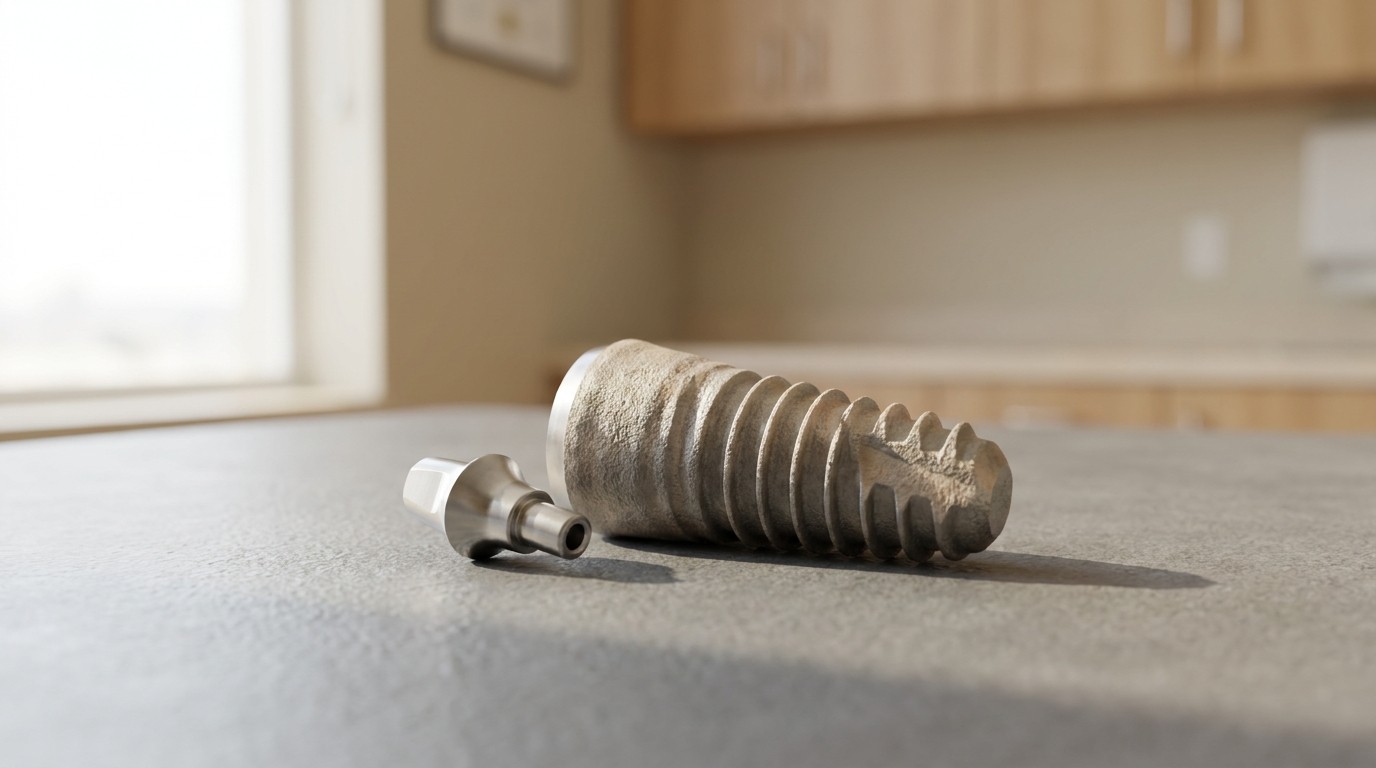
A single tooth implant is an artificial tooth root made of titanium, placed in the jawbone where the natural root used to be. Once it has bonded with the bone, a small connector called an abutment is attached, and a crown is fitted on top.
The Canadian Dental Association describes a dental implant as "an artificial root made of titanium metal." The American Association of Oral and Maxillofacial Surgeons (AAOMS, US) names three parts:
The implant: a titanium post that fuses to the jawbone through a process called osseointegration.
The abutment: the portion that rises above the gum line.
The crown: the visible tooth, made to give the appearance and function of a natural tooth.
The American Academy of Periodontology (US) points out that an implant "replaces a single tooth without sacrificing the health of neighboring teeth." It also says implants "integrate with your jawbone, helping to keep the bone healthy and intact."
What are the steps, from consultation to the final crown?
Getting a single tooth implant happens in stages. Your dentist first examines your mouth and takes x-rays, then places the implant in the jawbone under the gum. After several months of healing, an abutment is attached and the crown is fitted. Follow-up checkups during the next year confirm that everything is working well.
Stage | What happens | Typical timing |
|---|---|---|
Consultation and x-rays | Your dentist examines your mouth and takes x-rays of your head, jaw and teeth to plan the implant. | Before any surgery |
Implant placement | The titanium implant is placed in the jawbone beneath the gum tissue. | One surgical visit; sometimes the first and second stages are done together |
Healing (osseointegration) | The implant bonds with the bone and attaches to the gum. A temporary tooth can be worn. | Several months; two to six months according to the AAP |
Abutment | Once the tissue has healed, the connector is attached to the implant. | After healing |
Final crown | The crown is fitted to the abutment and checked against your bite. | May take several appointments |
Follow-up | Checkups make sure your bite is right and the implant is not loose. | During the following year |
Sources for this table: the Canadian Dental Association and the American Academy of Periodontology (US), checked November 2026.
How long does the whole process take?
For most people, a single tooth implant takes several months from placement to the final crown, because the implant has to bond with the jawbone before it can carry a crown. The Canadian Dental Association says "it can take several months to heal," and fitting the crown may take several more appointments after that.
Sources describe the window a little differently. The American Academy of Periodontology (AAP) says "over the next two to six months, the implant and the bone are allowed to bond together." The AAOMS says the process "usually takes several months".
Some people can have the implant and a replacement tooth placed in one visit, according to ADA MouthHealthy (US). Ask whether that suits you.
Does getting a dental implant hurt?
Expect some soreness after implant surgery. MyHealth Alberta says you may have swelling, tenderness or both for a few days, and your dentist may give you pain medicine. In one small study, patients rated implant placement as mildly to moderately painful, with symptoms easing over the first few days.
In a study where patients kept a daily pain diary, people rated implant placement as "a mild to moderately painful and anxiety-provoking procedure," with symptoms mainly in the first 3 days. A 2021 review comparing the two procedures concluded that implant placement "is less unpleasant than tooth extraction," though individual factors can raise pain for some people.
Ask your dentist how the area will be numbed, and take pain relief only as your dentist or pharmacist directs. If nerves are the biggest hurdle, ask about oral sedation: a prescribed calming pill taken before the appointment. You stay awake and able to respond, and Dr. Lesko reviews your health history and medications first to confirm it is a safe fit. Our guide to implant recovery covers the first days at home.
How long do dental implants last?
Dental implants have high long-term survival rates, and in research the implant itself has lasted better than the crown on top. In a large 2012 review, 95.2% of single tooth implants survived 10 years, compared with 89.4% of their crowns. Good daily care and regular checkups help protect both parts.
The implant and the crown age differently
A 2012 systematic review of single crowns on implants found implant survival of 97.2% at 5 years and 95.2% at 10 years. Crown survival was 96.3% at 5 years and 89.4% at 10 years, and the authors noted that "technical, biological, and aesthetic complications were frequent."
The AAOMS says that "if properly cared for, dental implants can last a lifetime," and the AAP says the same is possible "with a proper oral health routine." MyHealth Alberta adds a balancing point: "you may need to have more surgery in the future" to keep an implant in place.
What shortens an implant's life
Smoking. A 2013 meta-analysis found that smoking was associated with an increased risk of implant failure.
Gum disease around the implant. The AAP lists a past gum disease diagnosis, poor plaque control, smoking and diabetes as risk factors for disease around implants.
Grinding or clenching. A 2024 meta-analysis found implants in probable grinders had a significantly higher risk of failure.
Not bonding in the first place. The CDA notes that in some cases an implant is not successful "because it didn't bond to the bone."
The CDA says implants need cleaning with a toothbrush and floss like natural teeth, plus regular checkups.
What affects the cost of a dental implant?
The cost of a single tooth implant depends on what your mouth needs, so two people with the same gap can have very different plans. Whether a tooth must come out first, whether you need a bone graft, the x-rays and materials, and the crown all play a part. A written estimate after your exam is the reliable answer.
The American Association of Oral and Maxillofacial Surgeons (AAOMS, US) cost guide lists the factors that change the total:
Whether a tooth needs to be removed before the implant.
Whether you need a bone graft to add bone where it is lacking.
The x-rays and materials used.
The crown, which "varies tooth to tooth," and whether you wear a temporary crown while you heal.
Whether sedation is used.
How many teeth are being replaced.
The CDA adds that implants "can cost more than other kinds of replacement teeth and might not be covered by your dental plan." At TLC, coverage is verified before treatment, and you receive a written estimate after the exam and before any treatment is scheduled. Ask whether the estimate includes the implant, abutment and crown, and what the alternatives are.
Does insurance or the CDCP cover dental implants?
As of November 2026, the Canadian Dental Care Plan does not cover dental implants or any implant-related procedure, including crowns placed on implants, and these exclusions are "not eligible for reconsideration." The CDA notes that implants might not be covered by private dental plans either, so check your own plan before treatment.
The CDCP Dental Benefits Guide (effective April 1, 2026) states that "any types of crowns supported by implants, as well as all implant-related procedures, are not covered under the CDCP." It also lists ridge augmentation, bone grafts and fixed bridges as exclusions.
The CDCP covers removable dentures, services that "replace missing teeth," according to the CDCP coverage page, though it "may not pay the full amount," and a co-payment may apply based on your adjusted family net income. For a fuller answer, read does the CDCP cover implants. TLC is an approved CDCP provider and direct bills most major Canadian insurers.
Is an implant the right way to replace your missing tooth?
Dental implants might be right for you if you are in good general health, have healthy gums and have enough jawbone to hold one, according to the Canadian Dental Association. If bone is lacking, a bone graft may be possible. A bridge or a denture can also replace one tooth, and an exam is the only way to compare them for you.
Your neighbouring teeth. An implant does not depend on the teeth beside the gap.
Your health. ADA MouthHealthy says chronic illnesses such as diabetes may interfere with healing after surgery.
Smoking. Using tobacco can slow healing, and smoking is linked with a higher risk of implant failure.
To go deeper, read about who is a good candidate and how to choose between an implant, bridge or denture.
Frequently Asked Questions
Will a single tooth implant look like my own teeth?
The crown on an implant is made to give the appearance and function of a natural tooth, according to the American Association of Oral and Maxillofacial Surgeons. The Canadian Dental Association says fitting the replacement tooth can take several appointments, and checkups afterward make sure your bite is right.
Can I have a temporary tooth while the implant heals?
It may be possible. The American Academy of Periodontology says a temporary tooth can be worn while the implant bonds with the bone, and ADA MouthHealthy says your dentist may give you a temporary crown, bridge or denture. The AAOMS cautions that a temporary crown placed on surgery day is for appearance only, not for chewing or biting.
Can I get an implant if I smoke?
Smoking matters for implants. A 2013 meta-analysis linked smoking with a higher risk of implant failure, and MyHealth Alberta advises no smoking for at least 24 hours after dental surgery because it can delay healing. Talk openly with your dentist about smoking so your plan reflects your real risk.
Who places the implant, a dentist or a specialist?
Either can. The Canadian Dental Association says your dentist may place the implant or refer you to a specialist, such as a periodontist or an oral and maxillofacial surgeon. Prosthodontists specialize in placing crowns, bridges and dentures on implants. Ask during your consultation who will handle each stage of your care.
Talk it through with Dr. Kyle Lesko in Leduc
If a missing tooth has been on your mind, book online or call 780.980.5115 to talk through your options with Dr. Kyle Lesko at 5209 Discovery Way #4 in Leduc. Patients are welcome from Leduc and the greater Edmonton area. Bring your insurance or CDCP details and a list of your medications and medical conditions, and you will receive a written estimate after your exam, before any treatment is scheduled.
Sources
Checked in November 2026. Coverage rules and recommendations change, so confirm current details with the organisations below.
Dental Implants, Canadian Dental Association
Dental Implants, MyHealth Alberta
Dental Surgery: What to Expect at Home, MyHealth Alberta
Canadian Dental Care Plan: Dental Benefits Guide, Government of Canada
What the Canadian Dental Care Plan covers, Government of Canada
Single Tooth Dental Implants, American Academy of Periodontology (US)
Peri-Implant Diseases, American Academy of Periodontology (US)
How Do Dental Implants Work?, American Association of Oral and Maxillofacial Surgeons (US)
How Much Are Dental Implants?, American Association of Oral and Maxillofacial Surgeons (US), myoms.org
Dental Implant Surgery, American Association of Oral and Maxillofacial Surgeons (US)
Implants, ADA MouthHealthy (US)
Systematic review of the survival rate and the incidence of biological, technical, and aesthetic complications of single crowns on implants, Jung and colleagues, Clinical Oral Implants Research, 2012
Smoking, Radiotherapy, Diabetes and Osteoporosis as Risk Factors for Dental Implant Failure, Chen and colleagues, PLoS One, 2013
Bruxism and dental implants: a systematic review and meta-analysis, Häggman-Henrikson and colleagues, Journal of Oral Rehabilitation, 2024
Pain and anxiety following the placement of dental implants, Hashem and colleagues, International Journal of Oral and Maxillofacial Implants, 2006
Pain Experience after Dental Implant Placement Compared to Tooth Extraction, AlQutub, International Journal of Dentistry, 2021
About
Featured Posts


Explore Topics